
The Louisville Home Buying Process, Step by Step (2026 Guide)
Buying Process · Louisville & Southern Indiana
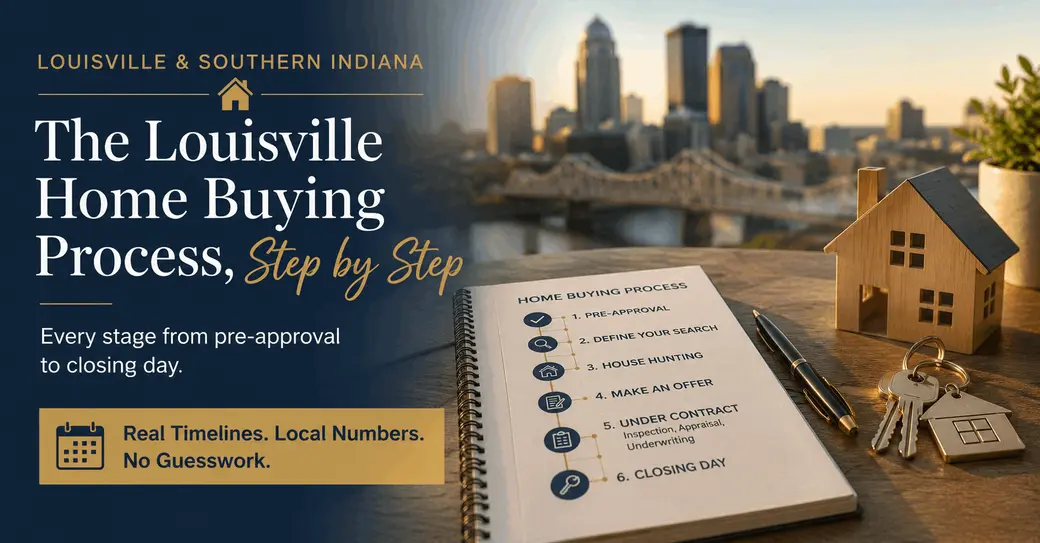
The Louisville Home Buying Process, Step by Step
Every stage from pre-approval to closing day, with real local timelines instead of guesses.
If you're buying a home in Louisville or Southern Indiana, the process runs through six stages: getting pre-approved, defining your search, house hunting, making an offer, the under-contract period (inspection, appraisal, underwriting), and closing. Start to finish, most buyers are looking at 6 to 10 weeks once they're under contract on the right house — sometimes longer if the house search itself takes a while first.
That's the short answer. Here's what actually happens at each stage, what it costs, and where Louisville and Southern Indiana buyers hit different rules.
Price and payment are two different conversations — this timeline is really about the second one.
Not sure which stage you're actually in yet? Let's talk through your timeline before you start touring homes.
Talk With TamaraQuick-Answer Summary
| 1–3 days Pre-approval, once documents are in | 46–49 days Average time on market, Greater Louisville | 21–35 days Offer accepted to closing, locally | 2–3 months Typical total, pre-approval to keys |
Step 1: Get Pre-Approved Before You Look
Direct answer: Pre-approval is a lender's written estimate of what you qualify to borrow, based on your income, debt, and credit — and it should happen before you tour a single house, not after you find one you like.
This isn't the same as a "pre-qualification," which is a quick, unverified estimate. Pre-approval involves an actual credit pull and document review, and it's what a seller's agent will ask to see before taking your offer seriously in a market where well-priced homes are still moving at a reasonable pace.
At today's rates — Freddie Mac's weekly survey put the 30-year fixed average at 6.66% as of August 27, 2026, and it moves week to week — the difference of even half a percentage point on your rate changes your monthly payment meaningfully. This is exactly why price and payment aren't the same conversation: two buyers looking at the same $300,000 house can have very different monthly numbers depending on their rate, loan type, and how they structure their down payment.
If cash for a down payment is the sticking point, Kentucky Housing Corporation's Down Payment Assistance program currently offers up to $12,500 toward down payment, closing costs, and prepaids, structured as a 15-year second mortgage. It's worth discussing with your lender before you assume you need 20% down. (More detail in our KHC Down Payment Assistance guide.)
Step 2: Define Your Search and Bring in an Agent
Direct answer: This is where you turn "I want to buy a house" into a specific, workable plan — price range based on actual payment (not just what you're approved for), target areas, and non-negotiables versus nice-to-haves.
Louisville and Southern Indiana aren't one market — Jefferson County, Bullitt County (Shepherdsville), Hardin County (Elizabethtown), and the Southern Indiana river cities (Jeffersonville, New Albany, Clarksville) each carry different tax structures, insurance costs, and price points. What you can afford in one area doesn't automatically translate to another. This is also the stage to decide how firmly you want to hold to "location" versus "financial fit" — a more desirable ZIP code isn't automatically the better financial decision once you factor in taxes, commute, and total payment.
Step 3: House Hunting
Direct answer: How long this takes depends entirely on your criteria, your budget, and what's available — but current Greater Louisville Association of REALTORS® data shows homes are averaging 46–49 days on the market, so a search that takes several weeks to a couple of months is normal, not a sign anything's wrong.
Inventory has loosened compared to a few years ago — more than 4,000 homes were on the market in Greater Louisville as of mid-2026, a meaningful increase year over year — which generally means less pressure to rush, but well-priced, move-in-ready homes in popular areas can still draw quick, competitive interest. Southern Indiana communities like Jeffersonville and New Albany, and Kentucky communities like Shepherdsville and Elizabethtown, tend to see less competition than the core Louisville metro, which can work in your favor if location flexibility is on the table.
Ready to see what's actually on the market right now?
Start Your Home SearchStep 4: Make an Offer
Direct answer: Your offer is more than price — it includes your financing terms, proposed closing date, contingencies (inspection, financing, appraisal), and any concessions you're requesting, and all of it is negotiable.
This is where your agent's read on the specific listing matters most: how long it's been on market, whether the seller has already dropped price, and what comparable homes nearby have actually sold for (not just listed for). A financially sound offer accounts for the full picture — purchase price, but also closing costs, any seller concessions you're requesting, and how the offer terms affect your actual monthly payment down the line.
Step 5: Under Contract — Inspection, Appraisal, and Underwriting
Direct answer: Once your offer is accepted, you're "under contract," and this stage typically runs 21–30 days locally, covering the home inspection, the lender's appraisal, and final underwriting of your loan.
Home Inspection
Usually scheduled within the first week or two of being under contract. A home inspection surfacing issues isn't a reason to panic — it's information, and it's your opportunity to negotiate repairs, a price adjustment, or a credit before you're locked in. (We cover this in more detail in Home Inspections Aren't Bad News.)
Appraisal
Your lender orders an independent appraisal to confirm the home's value supports the loan amount. If the appraisal comes in below the purchase price, that's a negotiation point, not an automatic deal-killer.
Underwriting
Your lender verifies everything on your loan application — income, assets, debt, the appraisal, and title work. This is also the stage where buyers most often accidentally cause their own delays (more on that below).
According to Louisville-area title professionals, most closings in the region take between 21 and 30 days from contract to close when financing, title, and documentation go smoothly — nationally, ICE Mortgage Technology data puts the average purchase-loan closing timeline closer to 42 days, so the Louisville/Southern Indiana market tends to move a bit faster than the national norm when a file is clean.
Step 6: Closing Day
Direct answer: Closing is where you sign the final paperwork, pay your remaining closing costs and down payment, and legally take ownership — and Kentucky and Indiana handle the legal side of this step a little differently, which matters if you're comparing homes on both sides of the river.
In Kentucky, preparing the deed and mortgage documents is legally considered the practice of law, so those documents must be prepared by a licensed attorney — that's settled under Kentucky case law, including the Kentucky Supreme Court's 2003 ruling in Countrywide Home Loans v. Kentucky Bar Association. The closing itself, however, doesn't legally require an attorney to conduct it — a non-attorney closing agent can run the actual signing, as long as they stick to ministerial tasks and don't give legal advice. In practice, most Louisville-area closings are still handled through attorney-affiliated title companies by custom, which is why it often feels like an attorney-required process even though the closing itself isn't strictly mandated to be attorney-run. Indiana has no equivalent deed/mortgage-preparation requirement — closings there are typically handled entirely by a title company. If you're weighing a Louisville purchase against a Jeffersonville or New Albany one, ask your title company how they staff each state's closing so you know what to expect. (Some Indiana closings also require wired funds rather than certified checks above certain amounts — this varies by title company, so confirm directly with whoever is handling yours.)
At the table, you'll sign the deed, the mortgage note, and loan documents; provide your remaining funds via cashier's check or wire; and receive your keys. Budget for closing costs in the range of 2–5% of the purchase price on top of your down payment — this is one of the most common places buyers underestimate their true cash-to-close.
Financial Snapshot: What This Actually Costs
On a $300,000 Louisville-area home at a 6.75% rate with 10% down ($30,000):
| $270,000 Loan amount | ~$1,750/mo Estimated principal & interest | $7,500–$12,000 Estimated closing costs (2.5–4%) | ~$97/mo Added payment if using KHC's $12,500 DAP |
With KHC's $12,500 DAP applied toward down payment/closing costs, the cash-to-close gap narrows meaningfully — though it adds an estimated $97/month second-mortgage payment at the program's current terms (15-year repayment at roughly 4.75% interest — confirm the exact rate with a KHC-approved lender, since it's subject to change).
These are illustrative numbers based on current rate and program data as of publication — your actual figures depend on credit, loan type, and the specific property. This is exactly the kind of math worth running with a lender before you fall in love with a listing.
Who Should Move Faster vs. Slower Through This Process
Move faster if: you're relocating for a job start date, a military PCS timeline, or you're already pre-approved and simply waiting on the right listing. In these cases, having your inspector, lender, and title company lined up in advance shortens the under-contract stage meaningfully.
Take your time if: you're not on a deadline, you're still deciding between neighborhoods or between the Kentucky and Southern Indiana sides of the market, or your finances would benefit from a few more months of saving or credit improvement before you lock in a rate. Rushing the pre-approval or search stage to "keep up" with the market rarely pays off compared to buying the right house on solid financial footing.
Common Mistakes That Slow This Process Down
| 1 | Shopping before getting pre-approved Losing time — and sometimes the house — scrambling to line up financing after finding "the one." |
| 2 | Making a large purchase or opening new credit Between pre-approval and closing — one of the most common causes of last-minute underwriting delays. |
| 3 | Skipping the inspection to compete on offer terms Without fully understanding what you're waiving. |
| 4 | Underestimating closing costs And arriving at the table short on cash-to-close. |
| 5 | Not accounting for rate, tax, and insurance differences When comparing homes across Kentucky and Southern Indiana — the sticker price isn't the full financial picture. |
Frequently Asked Questions
How long does it take to buy a house in Louisville, KY?
Most buyers should budget 2–3 months total: pre-approval takes days, house hunting varies based on your criteria and current 46–49 day average market times, and the under-contract period (offer to closing) typically runs 21–35 days.
How long does closing take once I'm under contract in Louisville?
Local title professionals report most Louisville and Southern Indiana closings take 21–30 days from accepted offer to closing day when financing and documentation go smoothly, somewhat faster than the roughly 42-day national average.
Do I need an attorney to buy a house in Kentucky?
Kentucky law requires a licensed attorney to prepare the deed and mortgage documents, but the closing itself can legally be conducted by a non-attorney closing agent. In practice, most Louisville-area closings still go through attorney-affiliated title companies. Indiana has no equivalent deed/mortgage-preparation requirement — closings there are typically handled by a title company alone.
What's the first step in buying a home in Louisville?
Getting pre-approved by a lender, before house hunting. Pre-approval clarifies your real budget and payment, and sellers' agents generally expect to see it before taking an offer seriously.
How much are closing costs in Louisville, KY?
Budget roughly 2–5% of the purchase price for closing costs, on top of your down payment. Programs like KHC's Down Payment Assistance (up to $12,500) can help cover both down payment and closing costs for qualifying buyers.
Ready to Start?
If you're weighing where to begin — Louisville, Southern Indiana, Shepherdsville, or Elizabethtown — the smartest first move is figuring out your real numbers before you start touring homes.
Related Reading
| KHC Down Payment Assistance: What Louisville Buyers Should Know (2026) Full detail on the $12,500 program referenced in Step 1. |
| Home Inspections Aren't Bad News A deeper look at the inspection step covered in Step 5. |
| Louisville Home Buying Checklist (2026): 12 Smart Steps Before You Buy A checklist-format companion to this timeline. |
| FHA vs Conventional Loans in Louisville, KY Expands on the financing decision from Step 1. |
| How Much Home Can You Afford in Louisville KY (2026) Deepens the budgeting math in the Financial Snapshot. |
| Common Home Buying Mistakes in Louisville KY Extends the Common Mistakes section above. |
| Moving to Louisville KY: A Smart Relocation Guide For relocating buyers on a faster timeline. |
| New Construction vs. Resale in Louisville, KY (2026 Guide) Relevant if you're still deciding property type before starting this process. |
Get a clear read on your real budget and timeline before you're standing in a living room falling in love with a house.
Start Your Home Search With TamaraTamara West
502-819-2211 | tamara@tamarawestrealtor.com | GreaterLouisvilleLiving.com
Your Realtor for Life.
- Freddie Mac Primary Mortgage Market Survey — current 30-year rate: freddiemac.com
- Greater Louisville Association of REALTORS® data, via Spectrum News 1 — days-on-market and inventory figures: spectrumnews1.com
- Aristocrat Title — local closing timeline: aristocrattitle.com
- Kentucky Housing Corporation — Down Payment Assistance program details: kyhousing.org
- Countrywide Home Loans, Inc. v. Kentucky Bar Association, Ky. Supreme Court (2003) — governing case law on Kentucky closing-agent requirements: caselaw.findlaw.com
Categories
Recent Posts







GET MORE INFORMATION