
FHA vs Conventional Loans in Louisville, KY: Which Home Loan Should You Choose?

FHA vs Conventional Loans in Louisville, KY: Which Home Loan Should You Choose?
Buying a home in Louisville is exciting, but choosing the right mortgage can have a much bigger impact on your long-term finances than choosing the home itself.
Many buyers spend weeks comparing neighborhoods, floor plans, and asking prices, yet spend very little time comparing the mortgage options available to them. That can be an expensive mistake. The loan you choose affects your monthly payment, upfront costs, mortgage insurance, and how much you'll pay over the life of your loan.
If you're deciding between an FHA loan and a conventional loan, you're asking one of the most common questions Louisville homebuyers face.
The good news is that there isn't a one-size-fits-all answer. FHA loans generally make homeownership more accessible for buyers with limited savings or developing credit, while conventional loans often provide greater long-term savings for borrowers with stronger financial profiles.
Whether you're buying your first home, relocating to Louisville, or purchasing your next property, understanding these differences can help you make a confident financial decision.
If you're still determining your budget, start by reading our How Much Home Can You Afford in Louisville KY 2026? guide before comparing mortgage options.
Quick Answer
FHA loans generally work best for buyers with smaller down payments, developing credit, or higher debt-to-income ratios. Conventional loans are often the better choice for buyers with stronger credit because they may offer lower long-term borrowing costs and mortgage insurance that can usually be removed after enough equity is built.
The right mortgage depends on your credit profile, available savings, monthly budget, and long-term homeownership goals.
FHA vs Conventional Loans at a Glance
| Feature | FHA Loan | Conventional Loan |
|---|---|---|
| Backed By | Federal Housing Administration | Private lenders |
| Minimum Down Payment | Generally 3.5% for qualified borrowers | As low as 3% for qualified borrowers |
| Credit Flexibility | More flexible | Typically requires stronger credit |
| Mortgage Insurance | Required under FHA guidelines | Usually required with less than 20% down but often removable later |
| Best For | First-time buyers, buyers rebuilding credit | Buyers with stronger financial profiles |
Loan requirements change over time. According to the U.S. Department of Housing and Urban Development (HUD), FHA loan guidelines are periodically updated to reflect current lending standards.
What Is an FHA Loan?

An FHA loan is a mortgage insured by the Federal Housing Administration (FHA). Because approved lenders receive government-backed mortgage insurance, FHA loans generally have more flexible qualification requirements than many conventional mortgages.
According to the U.S. Department of Housing and Urban Development, the FHA was created to expand access to homeownership by reducing lender risk while helping qualified borrowers obtain financing.
An FHA loan may be a good option if you:
- Have limited savings for a down payment
- Are purchasing your first home
- Are rebuilding your credit
- Have a higher debt-to-income ratio
- Want to become a homeowner sooner rather than waiting years to save a larger down payment
Many buyers relocating to Louisville or nearby communities such as Shepherdsville, Elizabethtown, Mt. Washington, and Bullitt County begin their home search with FHA financing because it offers another pathway into homeownership.
If you're planning a move from another state, be sure to read our Moving to Louisville KY: A Smart Relocation Guide before beginning your home search.
Are There Kentucky Home Buyer Assistance Programs?
Many buyers don't realize that choosing a mortgage is only one part of the financing process.
Depending on your financial situation, you may also qualify for homebuyer assistance programs through the Kentucky Housing Corporation (KHC). These programs may provide eligible buyers with down payment assistance, affordable financing options, and homebuyer education.
Eligibility requirements vary based on income, purchase price, occupancy requirements, and other factors, so it's worth discussing available programs with your lender before selecting a mortgage.
What Is a Conventional Loan?
A conventional loan is a mortgage that isn't insured by the federal government. Instead, most conforming conventional loans follow lending standards established by Fannie Mae and Freddie Mac, two government-sponsored enterprises that help support the nation's housing finance system.
Conventional financing is often a strong choice for buyers who:
- Have established credit
- Have stable income
- Can comfortably afford the required down payment
- Plan to own their home for several years
- Want mortgage insurance that may eventually be removed
One of the biggest advantages of conventional financing is flexibility. While buyers putting less than 20% down typically pay private mortgage insurance (PMI), many conventional loans allow that insurance to be removed after sufficient equity has been built, depending on loan terms and lender requirements.
FHA vs Conventional: Which Loan Is Better for You?
There's no universal answer because every buyer's financial situation is different.
In general, FHA financing tends to benefit buyers who need greater flexibility during the qualification process, while conventional financing often rewards buyers with stronger credit and larger financial reserves.
FHA may be the better choice if you:
✔ You're buying your first home.
✔ You have limited savings for a down payment.
✔ You're rebuilding your credit.
✔ You have a higher debt-to-income ratio.
✔ You want to purchase sooner rather than waiting years to save more money.
Conventional may be the better choice if you:
✔ You have strong credit.
✔ You have consistent income.
✔ You plan to stay in your home for many years.
✔ You want mortgage insurance that can eventually be removed.
✔ You're looking to reduce your long-term borrowing costs.
Remember, choosing a mortgage isn't about finding the "best" loan. It's about finding the loan that best aligns with your financial goals.
How Do Credit Scores Affect Your Mortgage Options?
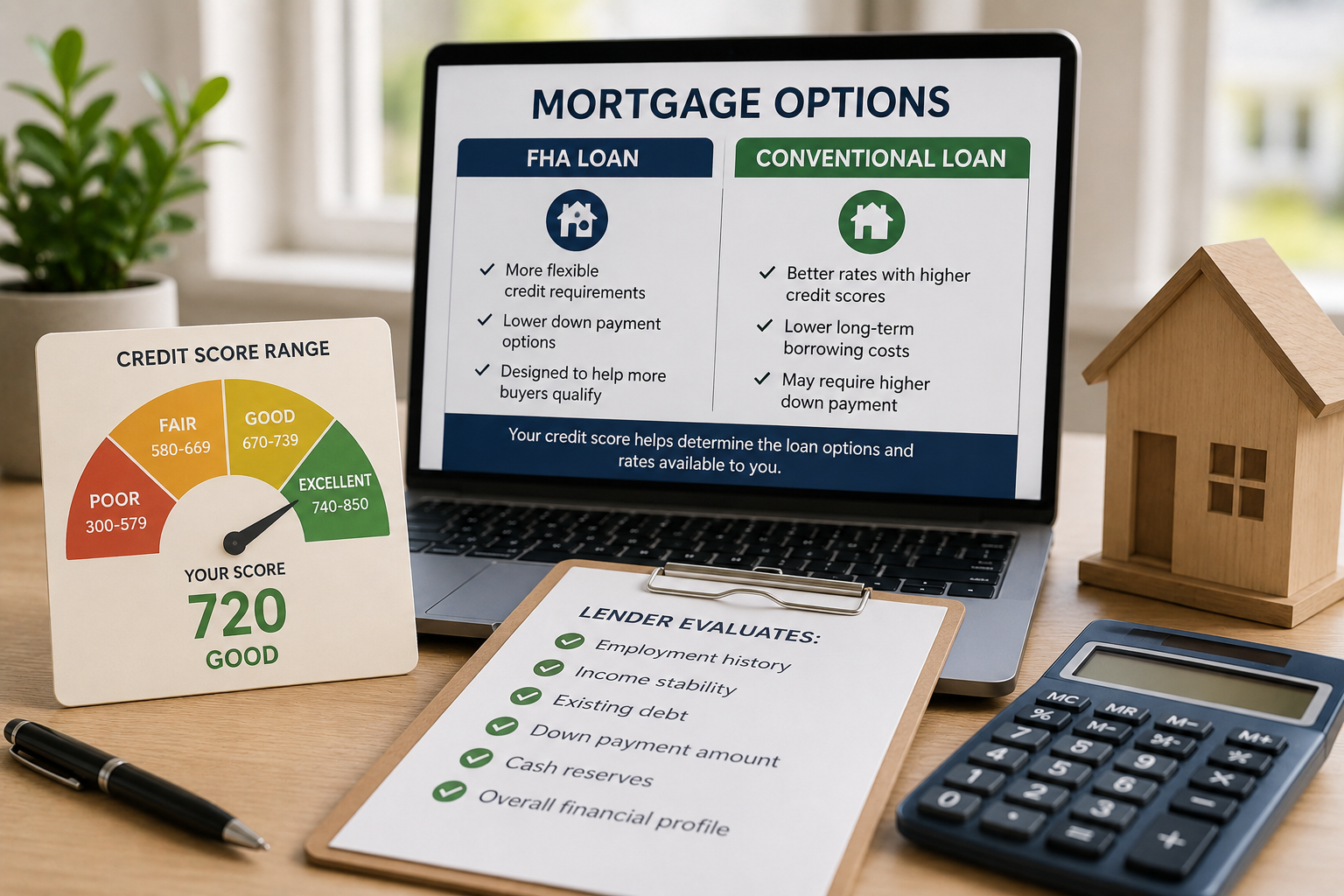
Your credit score is one of the most important factors lenders consider when evaluating your loan application.
While FHA loans generally provide more flexibility for borrowers with developing credit, conventional loans often reward higher credit scores with better pricing and lower long-term borrowing costs.
However, credit score is only one part of the equation. Lenders also evaluate:
- Employment history
- Income stability
- Existing debt
- Down payment amount
- Cash reserves
- Overall financial profile
Rather than focusing on one number, lenders review your complete financial picture when determining which loan programs you may qualify for.
If you're just beginning the buying process, our Louisville Home Buying Checklist (2026): 12 Smart Steps Before You Buy explains how to prepare financially before meeting with a lender.
How Does Mortgage Insurance Compare?
Mortgage insurance is one of the biggest differences between FHA and conventional loans, and it's often overlooked by buyers focused only on interest rates.
In general, FHA loans require both an upfront mortgage insurance premium (UFMIP) and an annual mortgage insurance premium (MIP) for most borrowers. Conventional loans typically require private mortgage insurance (PMI) when the down payment is less than 20%, but PMI can often be removed after you build enough equity, depending on your loan terms and lender requirements.
Because of these differences, two loans with nearly identical interest rates can have significantly different monthly payments and long-term costs.
According to the U.S. Department of Housing and Urban Development (HUD), FHA mortgage insurance requirements vary depending on your loan amount, loan term, and loan-to-value ratio.
Down Payment Isn't the Whole Story
One of the biggest misconceptions among Louisville homebuyers is that they need a 20% down payment to purchase a home.
Fortunately, that's no longer true.
Many qualified buyers purchase homes with as little as 3% down through certain conventional loan programs or 3.5% down with an FHA loan.
For a $350,000 home, here's how different down payments compare:
| Down Payment | Amount |
|---|---|
| 3% | $10,500 |
| 3.5% | $12,250 |
| 5% | $17,500 |
| 10% | $35,000 |
| 20% | $70,000 |
While the down payment is important, it's only one part of your upfront investment.
You'll also want to budget for:
- Closing costs
- Earnest money
- Home inspection
- Appraisal
- Homeowners insurance
- Property tax prepayments
- Moving expenses
- Utility deposits
- Emergency home maintenance fund
Many first-time buyers underestimate these additional expenses, which can create unnecessary financial stress after closing.
For a complete step-by-step guide, read our Louisville Home Buying Checklist (2026): 12 Smart Steps Before You Buy.
What About Closing Costs?
Closing costs are separate from your down payment and typically include lender fees, title services, prepaid taxes, homeowners insurance, recording fees, and other expenses required to complete your purchase.
The exact amount depends on factors such as:
- Purchase price
- Loan type
- Lender
- Property taxes
- Homeowners insurance
- Whether the seller contributes toward closing costs
Before closing, your lender will provide a Loan Estimate and Closing Disclosure outlining these costs so you can review them before signing your final paperwork.
According to the Consumer Financial Protection Bureau (CFPB), comparing Loan Estimates from multiple lenders is one of the best ways to understand your financing options and identify potential savings.
Compare the Total Monthly Payment, Not Just the Interest Rate
Many buyers focus almost entirely on finding the lowest interest rate.
While interest rate is important, it doesn't tell the whole story.
Instead, compare your total monthly housing payment, including:
- Principal
- Interest
- Property taxes
- Homeowners insurance
- Mortgage insurance
- HOA dues (if applicable)
For example, two buyers purchasing identical homes could have similar interest rates but very different monthly payments because of mortgage insurance premiums, homeowners insurance costs, or property taxes.
If you're considering homes in both Kentucky and Southern Indiana, taxes may also affect your monthly budget.
Be sure to read our Kentucky vs Indiana Property Taxes in 2026: What Buyers Should Know to better understand these differences.
Louisville Market Tip
Louisville's housing market includes everything from historic Highlands homes and suburban neighborhoods in Jeffersontown to new construction communities in Bullitt County and Southern Indiana.
Because every neighborhood is different, sellers often evaluate offers based on more than just the purchase price.
Strong offers frequently include:
- Solid financing
- Flexible closing dates
- Reasonable contingencies
- Pre-approval from a reputable lender
- A buyer who appears financially prepared
Working with an experienced local real estate professional can help you build a competitive offer regardless of whether you're using FHA or conventional financing.
Common Mistakes Buyers Make When Choosing a Mortgage
Choosing the wrong mortgage isn't always about selecting the wrong loan program. Sometimes it's about overlooking important details.
Here are some of the most common mistakes buyers make:
Comparing only interest rates
A lower interest rate doesn't automatically mean a lower monthly payment or lower lifetime borrowing costs.
Ignoring mortgage insurance
Mortgage insurance can significantly affect your monthly payment, especially during the first several years of homeownership.
Shopping with only one lender
Different lenders may offer different rates, fees, and loan programs.
The CFPB recommends comparing multiple Loan Estimates before selecting your mortgage.
Stretching your monthly budget
Just because you're approved for a certain loan amount doesn't mean it's the right amount for your lifestyle.
Leave room in your budget for maintenance, emergencies, vacations, retirement savings, and unexpected expenses.
Forgetting future goals
Ask yourself:
- Will I stay here five years?
- Will my family grow?
- Could my income change?
- Do I expect to refinance later?
Choosing a mortgage should support your future, not just today's budget.
If you're preparing to buy, our Common Home Buying Mistakes in Louisville KY article covers additional mistakes that can cost buyers time and money.
Can You Refinance from an FHA Loan to a Conventional Loan?
Yes.
Many homeowners begin with an FHA loan and later refinance into a conventional mortgage after improving their financial position.
Common reasons include:
- Higher credit score
- Increased home equity
- Lower monthly payments
- Removing mortgage insurance (when eligible)
- Better loan terms
Whether refinancing makes financial sense depends on current interest rates, closing costs, your remaining loan balance, and your long-term plans.
A trusted lender can help you determine whether refinancing is the right move based on your individual circumstances.
Which Mortgage Is Right for You?
Both FHA and conventional loans can be excellent financing options.
The best choice depends on your:
- Credit profile
- Down payment
- Monthly budget
- Long-term financial goals
- Future plans
Rather than asking which loan is better, ask which loan best supports your financial future.
The answer may be different for every buyer.
Frequently Asked Questions
Is an FHA loan better than a conventional loan for first-time buyers?
Not necessarily. While FHA loans are popular with first-time buyers because they generally offer more flexible qualification requirements, many first-time buyers also qualify for conventional loans with low down payment options. The better choice depends on your credit score, available savings, debt-to-income ratio, and long-term financial goals.
What credit score do I need for an FHA or conventional loan?
Minimum credit score requirements vary by lender and loan program. In general, FHA loans tend to be more flexible for buyers with developing credit, while conventional loans often provide better pricing for borrowers with stronger credit profiles. Your lender will evaluate your complete financial picture, including your income, debt, employment history, and cash reserves.
Can I refinance from an FHA loan into a conventional loan?
Yes. Many homeowners refinance from an FHA loan into a conventional mortgage after improving their credit or building enough equity. Refinancing may allow eligible borrowers to eliminate mortgage insurance, lower their monthly payment, or secure different loan terms. Whether refinancing is beneficial depends on your financial goals, interest rates, and closing costs.
Do I really need a 20% down payment?
No. One of the biggest myths in real estate is that every buyer needs a 20% down payment. Many qualified buyers purchase homes with much less, depending on the loan program they choose. Keep in mind that while a smaller down payment can help you buy sooner, it may also affect mortgage insurance and your monthly payment.
Which loan usually has the lower monthly payment?
There isn't a universal answer. An FHA loan may allow you to purchase with less money upfront, while a conventional loan may reduce long-term monthly costs because private mortgage insurance can often be removed once sufficient equity is reached. Comparing the complete monthly payment, including taxes, insurance, and mortgage insurance, provides a more accurate picture than comparing interest rates alone.
Are FHA loans harder for sellers to accept?
Not necessarily. While some sellers have preferences regarding financing, an FHA loan does not automatically make your offer less competitive. Sellers often consider the overall strength of an offer, including the purchase price, financing, contingencies, closing timeline, and the buyer's level of preparation. A strong pre-approval and guidance from an experienced local real estate professional can help strengthen your offer regardless of the loan type.
Should I get pre-approved before looking at homes?
Absolutely. Mortgage pre-approval helps you understand your budget, identify the loan programs you qualify for, and demonstrate to sellers that you're a serious buyer. In a competitive market like Louisville, having a pre-approval letter can also strengthen your offer when you're ready to purchase.
If you're preparing to start your home search, our How Long Does It Take to Buy a Home in Louisville KY? guide explains what to expect from pre-approval through closing.
Final Thoughts
Choosing between an FHA loan and a conventional loan isn't about finding a universally "better" mortgage. It's about selecting the financing option that best supports your financial goals, your monthly budget, and your long-term plans.
For some Louisville buyers, an FHA loan provides the opportunity to become homeowners sooner by offering more flexible qualification requirements. For others, a conventional loan may deliver greater long-term savings through lower overall borrowing costs and mortgage insurance that can often be removed after enough equity has been built.
The most informed buyers look beyond the advertised interest rate. They compare the complete monthly payment, understand the true cost of mortgage insurance, evaluate their future plans, and explore every available financing option before making a decision.
If you're planning to buy a home in Louisville, Shepherdsville, Elizabethtown, Mount Washington, or Southern Indiana, taking the time to understand your mortgage options today can help you avoid costly surprises tomorrow.
Ready to Buy a Home in Louisville?
Whether you're purchasing your first home, relocating to the Louisville area, or upgrading to your next property, I'm here to help you navigate every step of the buying process.
From connecting you with trusted local lenders to helping you compare neighborhoods and negotiate the strongest possible offer, my goal is to help you buy with confidence.
If you're ready to begin your home search, contact me today. Together, we'll create a home buying strategy that's tailored to your goals, your budget, and your future.
Tamara West
📞 502-819-2211
📧 tamara@tamarawestrealtor.com
🌐 https://greaterlouisvilleliving.com/
Sources
- U.S. Department of Housing and Urban Development (HUD), FHA Home Loans
https://www.hud.gov/buying/loans - Federal Housing Administration (HUD), FHA Program Information
https://www.hud.gov/program_offices/housing/fhahistory - Fannie Mae
https://www.fanniemae.com/ - Freddie Mac
https://www.freddiemac.com/ - Consumer Financial Protection Bureau, Buying a Home
https://www.consumerfinance.gov/owning-a-home/ - Consumer Financial Protection Bureau, Loan Estimate Guide
https://www.consumerfinance.gov/owning-a-home/loan-estimate/ - Kentucky Housing Corporation (KHC)
https://www.kyhousing.org/
Categories
Recent Posts









GET MORE INFORMATION