
Sell As-Is in Louisville: Why Listing Usually Nets More
Seller Strategy · Louisville & Southern Indiana
Sell My House As-Is in Louisville: Cash Offer vs. Listing (2026 Net Math)
Same house, three paths: what each one puts in your pocket, and how long it takes.
You have a house that needs work. Maybe the roof is near the end of its life, maybe the furnace is 20 years old, or maybe you inherited a place and can't take on a renovation. The postcards and the yard signs say "We Buy Houses, Any Condition." Before you call one, it helps to know what that convenience actually costs you in dollars.
This guide runs the same Louisville house through three paths: a cash offer from an investor, listing it as-is, and fixing the big items first. You'll see the money that ends up in your pocket, how long each path takes, and the situations where cash really is the better call.
On a typical Louisville house that needs about $25,000 of work, listing it as-is usually puts far more money in your pocket than an investor cash offer. In our example, the cash offer nets about $27,100 and the as-is listing nets about $79,300, a gap of roughly $52,000, for about two extra months of waiting. Fixing the house first adds only about $7,600 more and needs $25,000 of your cash up front. A cash offer is the right call when time, money to carry the house, or the home's condition rules out a regular buyer.
| $27,122Cash offer: in your pocket | $79,250List as-is: in your pocket | $86,835Fix, then list: in your pocket |
| If your situation is... | Usually the better path | Why |
|---|---|---|
| You can cover the payment for 2–3 more months | List as-is | Open-market buyers pay much closer to market value |
| The home has a problem most lenders won't finance (failing roof, major structural issue) | Cash offer, or list to cash and rehab buyers | Many loan types require repairs before closing |
| You face a deadline you can't move (foreclosure date, job start, estate deadline) | Cash offer | Closes in about 1–2 weeks |
| You have cash, time, and a contractor you trust | Repair first, then list | Can net a bit more, if repairs stay on budget |
All dollar figures in this article are an illustrative example built from October 2026 Louisville MLS data. Your house will be different. A free, written net-proceeds estimate on your actual home is the best next step.
The sale price is not the number that matters. The money left in your pocket, and how long it takes to get there, is.
Have a house that needs work and not sure which path fits? Let's talk it through, no pressure.
Talk With TamaraKey terms in plain English
| Term | What it means | Example from this article |
|---|---|---|
| As-is | You sell the house in its current condition and don't agree to make repairs. Buyers can still inspect and still ask. | Selling with the old roof and old furnace still in place |
| ARV (after-repair value) | What the house would sell for once it's fixed up. Investors start their math here. | $290,000, the October 2026 Louisville median sale price |
| Cash buyer / investor | A person or company that buys with their own money, usually to fix and resell or rent. Often advertises "We Buy Houses." | Offers $178,000 on our example house |
| iBuyer | A large company that makes instant online cash offers and charges a service fee. | Opendoor, Offerpad |
| Net proceeds | The money you walk away with after every cost and your mortgage payoff. This is the number to compare, not the sale price. | $79,250 on the as-is listing path |
| Carrying costs | What it costs to keep owning the house each month while it sells: mortgage interest, property tax, insurance, utilities. | $1,400 a month in our example |
| Repair credit | Money you give the buyer at closing instead of fixing something they found at inspection. | $3,000 on the as-is listing |
| Sale-to-list ratio | The sale price as a percent of the asking price. | 97.8% in Louisville in October 2026 |
How a cash offer is calculated
Short answer: most investors start from what the house will be worth after repairs, take about 70% of that, and then subtract the repair cost. That's why cash offers usually land well below market value.
How it works
HomeLight's 2026 guide to Kentucky cash sales describes the rule most "We Buy Houses" investors use: the price they pay should not exceed 70% of the after-repair value, minus the cost of repairs. The remaining 30% covers the investor's own costs to buy, fix, hold, and resell the house, plus their profit.
Here is that math on our example house.
| Step | Math | Result |
|---|---|---|
| 1. Start with the after-repair value | October 2026 Louisville median sale price | $290,000 |
| 2. Take 70% | $290,000 × 0.70 | $203,000 |
| 3. Subtract the repairs the investor plans | $203,000 − $25,000 | $178,000 offer |
| 4. Compare with the fixed-up value | $178,000 ÷ $290,000 | About 61% |
Why some offers come in higher or lower
- Condition triggers: HomeLight notes that an HVAC system over about 15 years old or a roof near the end of its life can pull an offer down sharply.
- Foundation concerns: much of the region sits on karst limestone, so settling and sinkhole worries can bring in a structural engineer and a lower offer.
- Location: the same guide notes some investors stretch offers in high-growth areas such as Shepherdsville, where inventory has been tight.
- iBuyers like Opendoor generally pay more than a local investor but charge a service fee. That fee was historically about 5%, but Opendoor now sets it offer by offer and shows it in writing. iBuyers may also pass on homes that need major work. Ask for the fee and any repair deductions in writing.
Path 1: Take a cash offer
Who it is built for: sellers who need certainty and speed more than top dollar.
What you pay: very little at closing. Many cash buyers advertise that they cover the closing costs. You still owe the small Kentucky transfer tax, which is $0.50 for every $500 of the price. Kentucky law places this tax on the seller.
The catch: the price. You give up the most equity of any path.

| Step | Math | Result |
|---|---|---|
| Cash offer | From the table above | $178,000 |
| Kentucky transfer tax | $178,000 ÷ $500 × $0.50 | − $178 |
| Title and settlement fees | Paid by the buyer in this example | $0 |
| Carrying costs (about 2 weeks) | 0.5 month × $1,400 | − $700 |
| Money before your loan payoff | $177,122 | |
| Mortgage payoff (example) | − $150,000 | |
| Cash in your pocket | $27,122 |
Timeline: HomeLight reports that investor offers typically arrive in 24 to 48 hours, with closing in as little as 7 to 14 days.
Path 2: List the house as-is with an agent
Who it is built for: sellers who can carry the house for a couple more months and want the most money for the least work.
What you pay: agent compensation, title and settlement fees, the transfer tax, and usually a repair credit after the buyer's inspection.
The catch: a slower timeline, and a smaller pool of buyers if the home has a defect that blocks common loans (more on that below).
How it works
You price the house for its real condition, disclose what you know, and market it to every type of buyer: owner-occupants with conventional loans, cash buyers, and the same investors who send the postcards. When investors have to compete with other buyers in the open market, offers move up.
The math on our example house
We price the house at $255,000, which reflects the $25,000 of needed work plus a modest discount for the buyer taking on the project. In October 2026, Louisville homes sold for 97.8% of their final list price on average.
| Step | Math | Result |
|---|---|---|
| List price, priced for condition | $290,000 − $25,000 repairs − $10,000 buyer discount | $255,000 |
| Expected sale price | $255,000 × 97.8% | $249,390 |
| Agent compensation (5%, negotiable) | $249,390 × 0.05 | − $12,470 |
| Kentucky transfer tax | $249,390 ÷ $500 × $0.50 | − $250 |
| Title and settlement fees | Example | − $1,200 |
| Repair credit after inspection | Example | − $3,000 |
| Carrying costs (about 2.3 months) | 2.3 × $1,400 | − $3,220 |
| Money before your loan payoff | $229,250 | |
| Mortgage payoff (example) | − $150,000 | |
| Cash in your pocket | $79,250 |
Timeline: Louisville homes averaged 34 days on market in October 2026, and a financed closing usually takes about another month. Plan on roughly 2 to 2.5 months from listing to cash. For the full breakdown, see our guide to how long it takes to sell a house in Louisville.
"As-is" does not mean "no questions"
Listing as-is tells buyers you won't make repairs. It doesn't stop them from inspecting, and it doesn't stop them from asking for a credit. That's why our example includes a $3,000 repair credit. The difference is that you get to say no, and the buyer knew the condition going in.
Path 3: Fix the big items, then list
Who it is built for: sellers with cash on hand, a flexible timeline, and a contractor they trust.
What you pay: the repairs up front, plus everything in Path 2, plus about one extra month of carrying costs while the work gets done.
The catch: repair bills often run over budget, and the gain is smaller than most people expect.
| Step | Math | Result |
|---|---|---|
| List price after repairs | Louisville median | $290,000 |
| Expected sale price | $290,000 × 97.8% | $283,620 |
| Repairs paid up front | Roof, HVAC, paint, flooring (example) | − $25,000 |
| Agent compensation (5%, negotiable) | $283,620 × 0.05 | − $14,181 |
| Kentucky transfer tax | $283,620 ÷ $500 × $0.50 | − $284 |
| Title and settlement fees | Example | − $1,200 |
| Smaller repair credit | Example | − $1,500 |
| Carrying costs (about 3.3 months) | 3.3 × $1,400 | − $4,620 |
| Money before your loan payoff | $236,835 | |
| Mortgage payoff (example) | − $150,000 | |
| Cash in your pocket | $86,835 |
If the repairs run 20% over budget ($30,000 instead of $25,000), your net drops to about $81,835, only about $2,600 more than listing as-is.
The three paths side by side
| Cash offer | List as-is | Fix, then list | |
|---|---|---|---|
| Sale price | $178,000 | $249,390 | $283,620 |
| Your cash needed up front | $0 | $0 | $25,000 |
| Time to cash in hand | 1–2 weeks | About 2–2.5 months | About 3–3.5 months |
| Repairs you manage | None | None | All of them |
| Cash in your pocket | $27,122 | $79,250 | $86,835 |
| Risk | Lowest | Moderate (buyer inspection, financing) | Highest (budget overruns, delays) |
Example only. Assumes a $150,000 mortgage payoff, 5% agent compensation, $1,400 a month in carrying costs, and October 2026 Louisville MLS averages. Property tax proration is left out because you owe it on every path.
Curious what your house would net as-is versus a cash offer?
Get Your Free Net-Proceeds EstimateWhen a cash offer is the smarter move
Short answer: when the house can't realistically sell to a buyer using a regular loan, or when time costs you more than the price difference.
The home won't pass a lender's standards
FHA, VA, and many conventional loans require the house to meet basic safety and soundness standards. Under FHA rules, when an appraisal finds a condition that keeps the home from meeting those standards, the lender must make sure the repairs are done before the loan can be insured. Under current FHA rules, a roof with less than about two years of life left is a classic example that gets flagged (HUD proposed changing this roof rule in September 2026).
If your house has a failing roof, no working heat, an active leak, or a serious structural issue, many buyers simply can't get a loan for it. Your realistic buyers become cash buyers and rehab-loan buyers. That's still a market, and listing exposes you to all of them at once instead of one postcard company, but the price gap narrows.
This matters in the Elizabethtown and Radcliff area in particular, where VA loans are common near Fort Knox (see our guide to VA loans near Fort Knox). VA loans carry their own property standards, and the home must meet them before VA will guarantee the loan. See our FHA vs. conventional vs. VA guide for how each loan treats a home's condition.
Time is the real cost
- A foreclosure date is approaching and a 60-day listing won't beat it.
- You can't cover the payment, taxes, and insurance for another two or three months.
- The house is vacant and costing you insurance surcharges, utilities, and worry.
- Several heirs need a clean, quick settlement and nobody can manage a listing.
Get the cash offer anyway
Even if you plan to list, a written cash offer is useful. It sets your floor. If an investor will pay $178,000 today, you know exactly what the open market has to beat, and you can decide with real numbers instead of guesses.
Disclosure rules when you sell as-is
Short answer: selling as-is doesn't erase your duty to be honest about what you know. Kentucky and Indiana handle the paperwork differently.
Kentucky
Kentucky's seller disclosure law, KRS 324.360, applies to sales of single-family homes when a licensed real estate agent is paid on the sale. The Kentucky Real Estate Commission's Form 402, the "Seller's Disclosure of Property Condition," satisfies that requirement. The law exempts a few situations, including auctions and court-supervised foreclosures.
When you list as-is with an agent in Louisville, Shepherdsville, or Elizabethtown, you'll complete Form 402 and answer every question truthfully, including the roof, the basement, and any water problems. Completing it is how you protect yourself: the buyer can't later claim they didn't know about a problem you disclosed.
If you sell directly to an investor with no agent involved, the statute's form requirement may not apply, but that is not permission to hide a known defect. Talk to a real estate attorney before you sign a direct sale contract. I'm not an attorney, and this isn't legal advice.
Southern Indiana
Indiana's rule is broader. Indiana law generally requires sellers of 1 to 4 unit homes to complete the Seller's Residential Real Estate Sales Disclosure (State Form 46234) and give it to the buyer before accepting an offer, whether or not an agent is involved. Exemptions include court-ordered transfers, such as sales in the administration of an estate.
If your house is in Jeffersonville, Clarksville, New Albany, or anywhere in Southern Indiana, plan on completing State Form 46234 even for a cash sale.
What buyers will pay for your house right now
Short answer: Louisville is still a mild seller's market, but buyers have more choices than they did in spring, which makes accurate as-is pricing more important.
| Louisville, October 2026 | Figure |
|---|---|
| Median sale price | $290,000 |
| Average days on market | 34 days |
| Sale price as % of final list price | 97.8% |
| Sale price as % of original list price | 96.0% |
| Months of supply | 3.2 months |
Source: local MLS (Flexmls), city of Louisville, residential, pulled November 23, 2026.
Across the wider Louisville metro, active listings reached 4,820 in October, up from 4,167 in August, according to Realtor.com data published by the St. Louis Fed. More inventory means a fixer-upper competes with more move-in-ready homes. The gap between "sold for 97.8% of the final price" and "96.0% of the original price" tells you what happens when a house starts overpriced: it sits, gets reduced, and sells for less. Our guide on when to reduce your home price covers that trap. For the latest numbers, see the November 2026 Louisville market report.
Putting it together: three example sellers
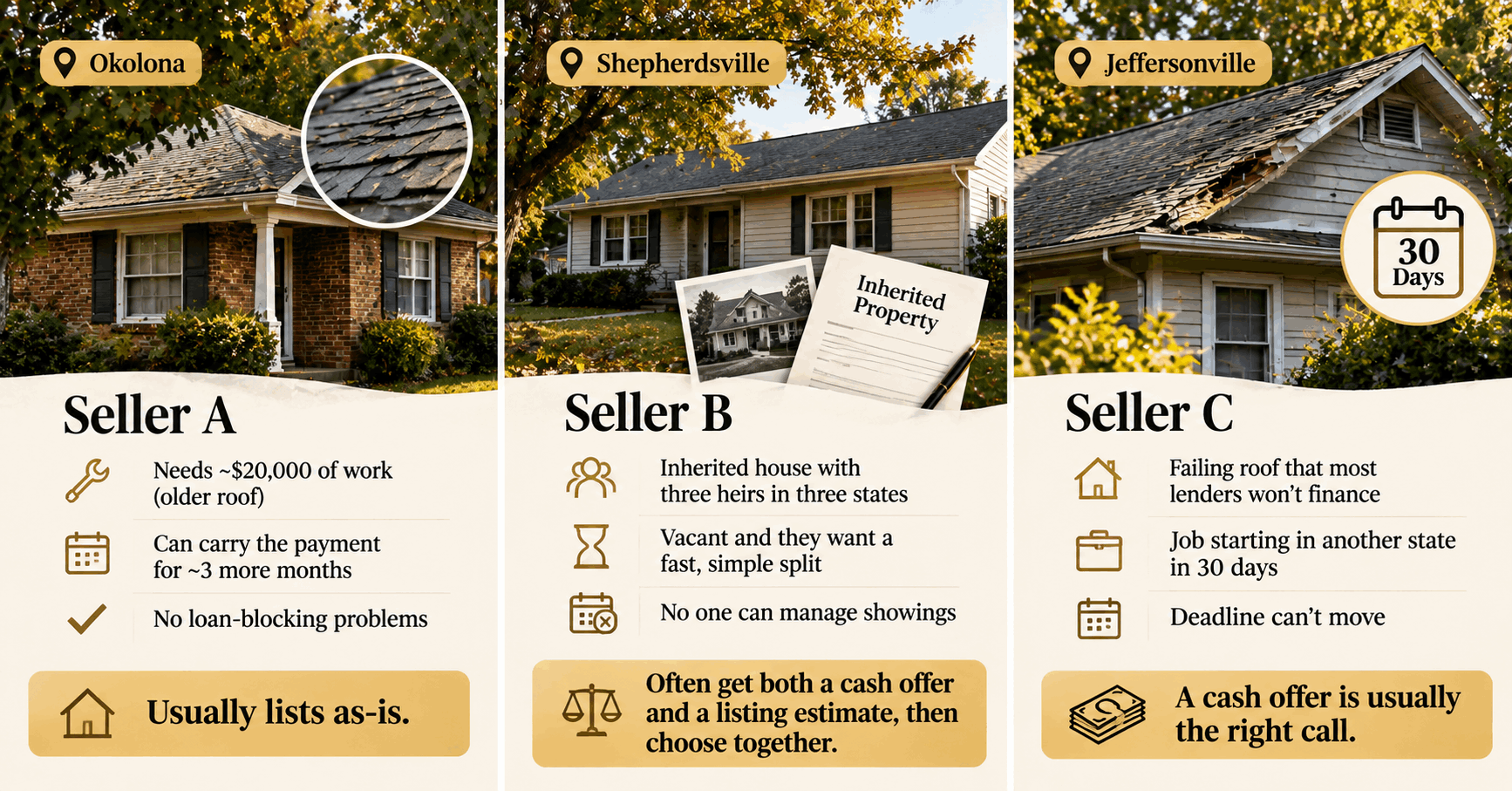 These are simplified examples to show how the decision works, not recommendations for your situation.
| 1 | Seller A: house in Okolona, older roof, can carry the payment.The house needs about $20,000 of work but has no loan-blocking problems. Seller A can cover the payment for three more months. Usually lists as-is. The extra two months are worth tens of thousands of dollars, and the inspection credit is manageable. |
| 2 | Seller B: inherited house in Shepherdsville, three heirs in three states.The house is vacant, the heirs want a fast, simple split, and nobody can manage showings. Often best served by getting a cash offer and a listing estimate side by side, then choosing together. If the listing nets far more and one heir can oversee a short listing, it may be worth it. If not, the cash offer gives everyone a clean close. |
| 3 | Seller C: home in Jeffersonville with a failing roof and a job starting in another state in 30 days.Most lenders won't finance the house until the roof is replaced, and the deadline can't move. A cash offer is usually the right call, but Seller C should get at least two or three offers and complete the Indiana disclosure form either way. |
Common mistakes when selling as-is
| 1 | Comparing sale prices instead of net proceedsA higher price with a big repair credit can net less. Always compare the bottom line. |
| 2 | Taking the first cash offerOffers from different investors on the same house can vary by thousands. Get at least three, in writing. |
| 3 | Assuming "as-is" means no negotiationListed buyers still inspect. Budget for a possible credit. |
| 4 | Over-improving before sellingNew countertops rarely return their cost on a house that also needs a roof. |
| 5 | Pricing for the fixed-up valueAn as-is home priced like a renovated one sits, and price cuts cost more than an honest first price. |
| 6 | Skipping the disclosureLeaving a known problem off the form can cost far more after closing than it saves before. |
| 7 | Signing a contract you can't easily exitSome direct-purchase contracts include long inspection periods or assignment clauses that let the buyer sell your contract to someone else. Read the contract carefully, or have an attorney read it, before you sign. |
Your next steps
| 1 | Write down your real deadlineNote how many months of payments, taxes, and insurance you can comfortably carry. |
| 2 | List what's wrong with the houseStart with anything that could block a loan: roof, heating, electrical, plumbing, foundation, water. |
| 3 | Get two or three written cash offersThese set your floor. |
| 4 | Get a written net-proceeds estimate for an as-is listingAsk for one based on recent comparable sales near you. |
| 5 | Put the numbers side by sideCompare cash in your pocket and time to close, not sale price. |
| 6 | Check the disclosure form for your stateThat's Kentucky Form 402 or Indiana State Form 46234. Answer it honestly. |
| 7 | Decide, then commitPrice the house for its condition on day one if you list, or pick the strongest cash offer if time wins. |
Want to see your own numbers? I'll prepare a free, side-by-side estimate for your home: a cash offer range, an as-is listing range, and what you'd likely net from each.
Find Out What Your Home May Be WorthFor the full cost picture on any sale, read what it costs to sell a Louisville home in 2026 and our step-by-step guide on how to sell a house in Louisville.
Frequently asked questions
How much less is a cash offer than market value in Louisville?
Most investors use the 70% rule: about 70% of the home's after-repair value, minus repair costs. On a $290,000 Louisville house needing $25,000 of work, that is about $178,000, roughly 61% of the fixed-up value. iBuyers usually pay more but charge a service fee, historically about 5%, that now varies by offer.
Can I sell my house as-is in Kentucky without an agent?
Yes. You can sell directly to a cash buyer or to anyone else without an agent. Kentucky's seller disclosure form law (KRS 324.360) applies when a licensed agent is paid, but you should still be honest about known defects and have an attorney review any direct sale contract.
Do I still have to fill out a disclosure form if I sell as-is?
In Kentucky, yes, if you list with an agent: you'll complete KREC Form 402. In Southern Indiana, sellers of 1 to 4 unit homes generally must complete State Form 46234 before accepting an offer, with or without an agent. Selling as-is does not remove these requirements.
How fast can I sell a house for cash in Louisville?
Cash buyers typically make offers within 24 to 48 hours and can close in about 7 to 14 days. A listed home averaged 34 days on market in Louisville in October 2026, plus about a month for a financed closing.
Is it better to fix my house or sell it as-is in Louisville?
Usually it's better to sell as-is, or to fix only the items that block financing, such as the roof, heating, or electrical. In our example, a full $25,000 repair added only about $7,600 to the seller's net, and a 20% budget overrun cut that to about $2,600.
Related Reading
| What It Costs to Sell a Louisville Home in 2026 Every seller cost, line by line, on a $280,000 example. |
| How to Sell a House in Louisville, KY The full selling process from prep to closing. |
| How Long Does It Take to Sell a House in Louisville? Days on market and time to close, explained. |
| What Should I Do Before Selling in Louisville? Which small fixes pay off before you list. |
| When to Reduce Your Home Price in Louisville How to avoid the overpricing trap. |
| Louisville Housing Market: November 2026 Update The latest prices, inventory and sale-to-list numbers. |
| FHA vs. Conventional vs. VA in Louisville Why a buyer's loan type matters for a house that needs work. |
| VA Loans Near Fort Knox: Elizabethtown & Radcliff Buying Guide How VA property standards work in the Fort Knox area. |
Selling a house that needs work in Louisville, Southern Indiana, Shepherdsville or Elizabethtown? Start with real numbers.
See What Your Home May NetTamara West
KY & IN Realtor, Epique – KY Area Leader
502-819-2211 | tamara@tamarawestrealtor.com | GreaterLouisvilleLiving.com
Your Realtor for Life.
- HomeLight, how Kentucky cash buyers calculate offers and closing timelines: homelight.com
- Kentucky Real Estate Commission, Form 402 Seller's Disclosure of Property Condition: krec.ky.gov
- Indiana Seller's Residential Real Estate Sales Disclosure, State Form 46234: forms.in.gov
- HUD via Federal Register, FHA Minimum Property Requirements (May 29, 2026): federalregister.gov
- Realtor.com data via FRED, Louisville metro active listing count: stlouisfed.org
- Louisville market statistics: local MLS (Flexmls), city of Louisville, residential, October 2026, pulled November 23, 2026
Dollar examples in this article are illustrative, built from October 2026 Louisville MLS averages. They are not an offer, appraisal, or legal or tax advice. Your numbers will differ.
Categories
Recent Posts









 Broker Associate License ID: 247867MEET TAMARA WEST
Your Louisville & Southern Indiana Real Estate Broker
Since 2000, Tamara West has worked in finance, mortgage lending, real estate investing, and brokerage. That background shapes how she works with clients: she looks past the price of a home to what it actually costs you every month, and whether that fits where you're headed financially, not just where you'd like to live.
Licensed in both Kentucky and Indiana and based in Louisville, Tamara works with buyers, sellers, and investors across Louisville, Southern Indiana, Shepherdsville, and Elizabethtown. She's C2EX Certified through the National Association of Realtors, an ethics and professionalism endorsement, and currently serves as KY Area Leader at Epique Realty.
"A house has a price. It also has a payment, taxes, insurance, and a plan behind it. My job is to make sure you're looking at all of it, not just the number on the listing."
Buying or selling a home is a financial decision as much as a personal one. Tamara's approach combines the strategic side (rate, taxes, true cost of ownership, timing) with the practical side of getting a deal done, so you're making the move with the full picture in front of you, not just the highlight reel.
Why Work with Tamara West?- In finance, mortgage lending, and real estate since 2000
- Licensed broker in Kentucky and Indiana
- C2EX Certified/Endorsed through NAR
- KY Area Leader, Epique Realty
- Advisor-first approach: price is never the whole story
- Serving Louisville, Southern Indiana, Shepherdsville, and Elizabethtown
Check out these articles next
GET MORE INFORMATION