
Live in Indiana, Work in Louisville: Tolls & Taxes 2026
Kentucky vs Indiana · Louisville KY & Southern Indiana
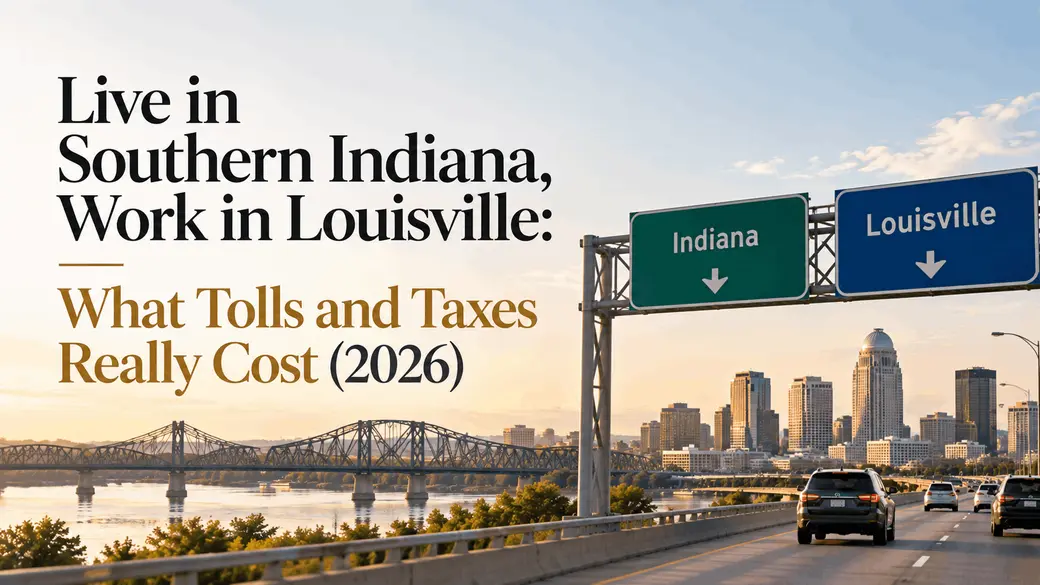
Live in Southern Indiana, Work in Louisville: What Tolls and Taxes Really Cost (2026)
Bridge tolls, the Kentucky-Indiana tax rules, and the yearly math for common commute patterns. Updated October 1, 2026.
If you live in Southern Indiana and work in Louisville, you pay Indiana state income tax (not Kentucky's) on your wages, Louisville's 1.45% nonresident wage tax, and a small leftover slice of your Indiana county tax. On $65,000 of wages, that simplified math comes out about $488 a year lower than living in Louisville. A full-time commuter with a RiverLink transponder who crosses at least 40 times a month pays about $1.40 per crossing, or roughly $698 a year, which mostly cancels out that tax savings. Use a toll-free bridge and the Indiana side comes out ahead; skip the transponder and it costs much more.
| about $1.40Per crossing with a RiverLink transponder and the frequent-user discount (40+ crossings a month) | 1.45%Louisville wage tax for people who live outside Jefferson County (residents pay 2.2%) | about $488Illustrative yearly income tax difference on $65,000 of wages, Clark County vs Louisville |
Tax figures are simplified: flat rates applied to gross wages, before deductions and exemptions. Your own numbers depend on your income, your county and your commute.
Plenty of buyers look across the river and see the same thing: a similar house, a different price, and a bridge in between.
The question they ask is usually "Is Indiana cheaper?" The better question is "Is Indiana cheaper for my commute and my paycheck?"
Two things decide that, and most listing searches skip both. The first is the bridge: which one you take, how often, and whether you have a transponder. The second is taxes: which state taxes your wages, and what Louisville charges people who work in Jefferson County.
This guide walks through both, in plain English, with the math shown step by step. Then it puts them together for a few common commute patterns, because the answer changes a lot depending on how often you cross.
Location isn't strategy. A cheaper address can cost more each month once the commute is in the math, or less, depending on how you cross.
Want to run this math on a home you're considering?
Talk With TamaraFirst, 9 terms that make the rest of this easy
| Term | What it means in plain English |
|---|---|
| RiverLink | The tolling system for three Ohio River bridges between Louisville and Southern Indiana. |
| Transponder | A small device on your windshield that pays tolls automatically from your prepaid account. |
| Prepaid account | A RiverLink account you load with money ahead of time. It's what gets you the lower toll rates. |
| Frequent-user discount | A 50% discount for transponder users who cross at least 40 times in a calendar month. |
| Reciprocal agreement (reciprocity) | A deal between Kentucky and Indiana: you pay state income tax on your wages only to the state you live in, not the state you work in. |
| Occupational license tax | Louisville's local tax on wages earned for work done inside Jefferson County. Think of it as a city wage tax. |
| Nonresident rate | The lower Louisville wage tax rate for people who live outside Jefferson County. |
| Indiana county income tax | A local income tax every Indiana resident pays to their county, on top of state tax. |
| Credit for local taxes paid outside Indiana | An Indiana tax credit that reduces your county tax when you've already paid a local wage tax to another state's city, like Louisville. |
How much are the Louisville bridge tolls in 2026?
A passenger car pays $2.79 per crossing with a RiverLink prepaid account and transponder, $4.18 with a prepaid account but no transponder, and $5.57 with no account. Frequent crossers can cut the transponder rate in half. These rates took effect July 1, 2026.
How it works
Three bridges charge tolls: the I-65 Abraham Lincoln Bridge, the I-65 Kennedy Bridge, and the Lewis and Clark Bridge, which connects Prospect, Kentucky, with Utica, Indiana (RiverLink).
Two bridges are free. The Clark Memorial Bridge (the Second Street Bridge) connects Jeffersonville with downtown Louisville, and the Sherman Minton Bridge (I-64) connects New Albany with West Louisville. TARC buses don't pay tolls, and riders aren't charged extra to cross (RiverLink).
Visual guide
Five bridges, two of them free
Listed west to east along the Ohio River
| Toll | Bridge | Connects (Indiana ↔ Kentucky) |
|---|---|---|
| TOLL-FREE | Sherman Minton I-64 · $0 |
New Albany ↔ West Louisville |
| TOLL-FREE | Clark Memorial (Second Street) US-31 · $0 |
Jeffersonville ↔ downtown Louisville |
| TOLLED | Kennedy I-65 · $2.79 with transponder |
Jeffersonville ↔ downtown Louisville |
| TOLLED | Abraham Lincoln I-65 · $2.79 with transponder |
Jeffersonville ↔ downtown Louisville |
| TOLLED | Lewis and Clark SR 265 / KY 841 · $2.79 with transponder |
Utica ↔ Prospect |
Tolled and toll-free crossings per RiverLink; car rate shown for a prepaid account with transponder. TARC buses don't pay tolls.
Rates rise every July 1. The two states agreed in 2013 to raise tolls each year by 2.5% or the rate of inflation, whichever is higher. This year's increase was 3.8%, based on April 2026 inflation (RiverLink).
| How you pay (passenger car, July 2026 to June 2027) | Toll per crossing |
|---|---|
| Prepaid account + transponder | $2.79 |
| Prepaid account + transponder + frequent-user discount | about $1.40 (50% off) |
| Prepaid account, no transponder | $4.18 |
| No account (bill mailed to you) | $5.57 |
Frequent-user rate: $2.79 × 50% = $1.395, shown rounded.
Visual guide
What one crossing costs, by how you pay
| No account (bill by mail) |
|
||
| Prepaid account, no transponder |
|
||
| Prepaid account + transponder |
|
||
| Transponder + frequent-user discount 40+ crossings in a calendar month |
|
Passenger car rates, July 1, 2026 to June 30, 2027 (RiverLink).
The frequent-user discount, explained
If one RiverLink transponder makes 40 crossings (20 round trips) in a calendar month, every crossing that month is half price. You don't sign up; it's applied automatically (RiverLink).
The fine print matters:
| 1 | It's counted per transponder, not per accountTwo cars on one account each need their own 40 crossings. |
| 2 | It resets every calendar monthA month with holidays or a vacation week can drop you under 40, and that month is full price. |
| 3 | Your account has to stay positiveTrips taken with a zero or negative balance don't count. Turn on auto-replenishment. |
| 4 | It only works with a RiverLink transponder in a passenger carAn E-ZPass from another agency, a trailer, or a tall roof load won't count. |
Visual guide
Will you reach the 40-crossing discount?
| 2 days a week Full price: $2.79 |
|
|||
| 3 days a week Full price: $2.79 |
|
|||
| 5 days a week Half price: about $1.40 |
|
Dashed line = 40 crossings, where the 50% discount starts
Typical month with about 21 workdays and one round trip per workday. Holiday or vacation months can drop a five-day commuter under 40. Illustrative.
What a year of tolls costs, by commute pattern
Here's the annual math, assuming about 250 workdays a year and one round trip (two crossings) per workday.
| Commute pattern | Math | Yearly tolls |
|---|---|---|
| 5 days a week, transponder, discount every month | 500 crossings × $1.395 | about $698 |
| 5 days a week, transponder, never hit 40 | 500 crossings × $2.79 | $1,395 |
| 3 days a week (hybrid), transponder | 300 crossings × $2.79 | $837 |
| 2 days a week (hybrid), transponder | 200 crossings × $2.79 | $558 |
| 5 days a week, no account | 500 crossings × $5.57 | $2,785 |
| Any schedule, toll-free bridge | Second Street or Sherman Minton | $0 in tolls |
Illustrative. Your real number depends on your schedule and how many months you clear 40 crossings.
Notice the surprise in that table. A three-day hybrid worker averages about 26 crossings a month, so they never reach the discount. They pay about $837 a year, more than a five-day commuter who qualifies every month (about $698).
Visual guide
A year of tolls, by commute pattern
| 5 days, no account |
|
||
| 5 days, transponder, never hit 40 |
|
||
| 3 days, transponder Costs more than 5 days with the discount |
|
||
| 5 days, transponder, discount every month |
|
||
| 2 days, transponder |
|
||
| Any schedule, toll-free bridge |
|
About 250 workdays a year, one round trip per workday. Illustrative.
How to set up the cheapest toll option, step by step
| 1 | Open a prepaid personal accountDo it before your first crossing. Online, by phone or at a RiverLink customer service center. |
| 2 | Get a RiverLink transponder for each car that crossesRiverLink offers a local transponder and an E-ZPass transponder. Only a RiverLink transponder counts toward the discount. |
| 3 | Set auto-replenishmentRiverLink's own example suggests about $56 for someone crossing 20 times a month at $2.79. |
| 4 | Check your crossing count near month-endYour account history shows month-to-date crossings, so you can see if you're on track for 40. |
Do I pay Kentucky income tax if I live in Indiana and work in Louisville?
No, not on your wages. Under the Kentucky-Indiana reciprocal agreement, Indiana residents are exempt from Kentucky income tax on wages, salaries and commissions (Kentucky Administrative Regulation 103 KAR 17:140). You pay Indiana's state income tax instead.
How it works
For 2026, Indiana's state income tax rate is 2.95%, and it's scheduled to drop to 2.90% in 2027 (Indiana Department of Revenue). Kentucky's 2026 rate is a flat 3.5% (Kentucky Department of Revenue).
So an Indiana resident pays a slightly lower state rate on the same paycheck:
| Step | Math | Result |
|---|---|---|
| 1. Kentucky state tax on $65,000 (Louisville resident) | $65,000 × 3.5% | $2,275 |
| 2. Indiana state tax on $65,000 (Indiana resident) | $65,000 × 2.95% | $1,917.50 |
| 3. Difference | $2,275 − $1,917.50 | $357.50 a year |
Simplified: flat rates on gross wages, before deductions and exemptions.
How to make sure your paycheck is set up right
Kentucky's 2026 withholding certificate (Form K-4) has a box for people who work in Kentucky and live in a reciprocal state, including Indiana. Checking it tells your Kentucky employer not to withhold Kentucky tax (Kentucky Department of Revenue).
| 1 | Give your employer a new Form K-4Check the reciprocal-state box so Kentucky tax stops coming out of your pay. |
| 2 | Ask whether payroll can withhold Indiana taxIf your employer doesn't, plan to make Indiana estimated payments so you don't owe a lump sum in April. |
| 3 | Check your first paystub after movingKentucky state withholding should be $0 and Louisville should show the 1.45% nonresident rate. |
Two exceptions to know
Reciprocity covers wages only. Other Kentucky income, such as rental income from a Louisville property you keep, is handled separately. And if you keep a place to live in Kentucky and spend more than 183 days there in a year, reciprocity doesn't apply (103 KAR 17:140).
Do Indiana residents pay Louisville's occupational tax?
Yes, if the work is done in Louisville. Louisville's occupational license tax applies to wages earned for work performed in Jefferson County, no matter where you live. The rate is 2.2% for residents and 1.45% for nonresidents, because nonresidents don't pay the 0.75% school board portion (Louisville Metro Revenue Commission).
How it works
Your Louisville employer withholds the 1.45% from your paycheck the same way it withholds federal tax. On $65,000 of wages:
| Step | Math | Result |
|---|---|---|
| 1. Louisville resident rate | $65,000 × 2.2% | $1,430 |
| 2. Nonresident rate | $65,000 × 1.45% | $942.50 |
| 3. Difference | $1,430 − $942.50 | $487.50 a year |
Simplified.
That looks like a big Indiana advantage. But there's one more local tax to add back.
Then comes your Indiana county tax, minus a credit
Every Indiana resident pays a county income tax. For 2026, the rate is 2.0% in Clark County (Jeffersonville, Clarksville, Sellersburg, Charlestown) and 1.89% in Floyd County (New Albany, Floyds Knobs, Georgetown) (Indiana Department of Revenue).
Indiana doesn't make you pay full local tax twice on the same wages, though. If you paid a local income tax to a city in another state, you can take a credit against your Indiana county tax. The credit is the smallest of three amounts: the local tax you actually paid, your out-of-state wages times your Indiana county rate, or the county tax you owe (Indiana Department of Revenue, Information Bulletin #32).
Here's what that looks like for a Clark County resident:
| Step | Math | Result |
|---|---|---|
| 1. Clark County tax before the credit | $65,000 × 2.0% | $1,300 |
| 2. Credit for Louisville tax paid | Smallest of $942.50, $1,300, $1,300 | − $942.50 |
| 3. County tax you still owe | $1,300 − $942.50 | $357.50 |
| 4. Total local tax (Louisville + Clark) | $942.50 + $357.50 | $1,300 |
Simplified. Your tax preparer applies the credit on your Indiana return.
In plain English: your total local tax ends up equal to your own county's rate. In Clark County that's 2.0% in total, and in Floyd County it's 1.89%, compared with Louisville's 2.2% resident rate.
Working some days from home in Indiana?
Days you work from your Indiana home aren't subject to Louisville's tax, but your county tax picks them up, so your total local tax stays about the same. Indiana treats remote work as done wherever you physically are (Indiana Department of Revenue, Information Bulletin #32), and Louisville's tax applies only to work done in Jefferson County. If at least 5% of your time was worked outside Louisville Metro, you can request a refund of Louisville tax withheld on those days with Form W-1REE (Louisville Metro Revenue Commission). Your Indiana county credit shrinks by the same amount, so the total still lands near your county rate.
Your first year is different
Indiana sets your county for local tax as of January 1, and that county applies for the whole year, even if you move (Indiana Department of Revenue, Information Bulletin #32). If you move from Louisville to Southern Indiana partway through a year, you generally won't owe Indiana county tax until the next January 1, and you'll file part-year returns in both states for the move year. So your first-year numbers won't match the examples in this article.
The full side-by-side: same paycheck, three addresses
On $65,000 of wages, the simplified state-plus-local income tax is about $488 a year lower for a Clark County resident and about $559 lower for a Floyd County resident than for a Louisville resident.
| On $65,000 of wages | Louisville resident | Clark County resident | Floyd County resident |
|---|---|---|---|
| State income tax | $2,275 (KY 3.5%) | $1,917.50 (IN 2.95%) | $1,917.50 (IN 2.95%) |
| Louisville occupational tax | $1,430 (2.2%) | $942.50 (1.45%) | $942.50 (1.45%) |
| Indiana county tax after credit | none | $357.50 | $286 |
| Total | $3,705 | $3,217.50 | $3,146 |
| Difference vs Louisville | none | $487.50 less | $559 less |
Floyd County math: $65,000 × 1.89% = $1,228.50, minus the $942.50 credit = $286. Simplified: flat rates on gross wages, before deductions, exemptions and other credits. Illustrative.
Visual guide
Same $65,000 paycheck, four addresses
State income tax Louisville wage tax Indiana county tax after credit
| Louisville |
|
|
| Clark County, IN |
|
|
| Floyd County, IN |
|
|
| Shepherdsville or Elizabethtown |
|
Simplified: flat rates on gross wages, before deductions and exemptions. Clark County tan segment is $357.50; Floyd is $286. Illustrative.
Now add the bridge
Taxes are only half the picture. Here's the same Clark County commuter with each toll pattern added:
| Clark County commuter, $65,000 wages | Taxes | Tolls | Total | vs Louisville resident ($3,705) |
|---|---|---|---|---|
| Toll-free bridge (Second Street) | $3,217.50 | $0 | $3,217.50 | $487.50 less |
| 2 days a week, transponder | $3,217.50 | $558 | $3,775.50 | $70.50 more |
| 5 days a week, discount every month | $3,217.50 | $697.50 | $3,915 | $210 more |
| 3 days a week, transponder | $3,217.50 | $837 | $4,054.50 | $349.50 more |
| 5 days a week, no account | $3,217.50 | $2,785 | $6,002.50 | $2,297.50 more |
Illustrative. Assumes 250 workdays and simplified tax math.
Visual guide
Clark County commuter vs living in Louisville: taxes plus tolls
| ← Indiana costs less | Indiana costs more → |
| Toll-free bridge |
|
$487.50 less | |||
| 2 days, transponder |
|
$70.50 more | |||
| 5 days, discount every month |
|
$210 more | |||
| 3 days, transponder |
|
$349.50 more | |||
| 5 days, no account |
|
$2,297.50 more |
Per year, $65,000 wages, versus a Louisville resident's $3,705. Center line is break-even. Illustrative and simplified.
What this tells you: for most transponder commuters, taxes and tolls roughly cancel out. The difference is a few hundred dollars a year either way, or about $6 to $30 a month. Commuting with no RiverLink account is the one pattern that clearly costs more.
That means the real Kentucky vs Indiana decision usually comes down to the house itself: price, property taxes, insurance, and how much of your day the drive takes. For those numbers, see the Kentucky vs Indiana cost of living comparison and the real dollar difference in KY vs IN property taxes.
Ready to compare homes on both sides of the river?
Start Your Home SearchWhat if I live in Shepherdsville or Elizabethtown and work in Louisville?
You pay Kentucky's 3.5% state tax plus Louisville's 1.45% nonresident rate, because Louisville's rate is based on where you live. Anyone living outside Jefferson County gets the nonresident rate, including Kentucky residents (Louisville Metro Revenue Commission).
How it works
On $65,000, the simplified math is $65,000 × 3.5% = $2,275 in state tax plus $65,000 × 1.45% = $942.50 in Louisville tax, for $3,217.50. That's the same total as the Clark County example, with no tolls, because the commute stays in Kentucky.
The tradeoff is distance. Shepherdsville (Bullitt County) and Elizabethtown (Hardin County) are I-65 commutes into Louisville, and Elizabethtown is a much longer drive than a Jeffersonville bridge crossing. Your time and fuel belong in the math too.
| Lives in, works in Louisville ($65,000) | State tax | Louisville tax | Indiana county tax after credit | Tolls (5 days, discount) | Total |
|---|---|---|---|---|---|
| Louisville | $2,275 | $1,430 | none | $0 | $3,705 |
| Shepherdsville or Elizabethtown | $2,275 | $942.50 | none | $0 | $3,217.50 |
| Clark County, IN | $1,917.50 | $942.50 | $357.50 | $697.50 | $3,915 |
Illustrative and simplified. Check your city and county for any other local taxes that apply where you live.
What about living in Louisville and working in Southern Indiana?
You keep paying Kentucky state tax, Indiana won't tax your wages at the state level, but Indiana county tax can still apply. Kentucky residents give their Indiana employer Form WH-47 to stop Indiana state withholding. That form doesn't stop Indiana county tax withholding, which employers still handle under Indiana's rules (Indiana Department of Revenue, Information Bulletin #33).
Louisville's occupational tax applies to work done in Jefferson County, so wages for work done entirely in Indiana generally aren't subject to it. If your job splits time between both sides of the river, ask payroll how the days are divided, and have your tax preparer confirm your exact situation.
What the toll and tax math doesn't capture
Tolls and income taxes are usually the smaller part of the decision. The bigger numbers sit inside the house payment.
| Factor | Why it matters | Where to dig in |
|---|---|---|
| Home price | Sets your loan size and your payment for 30 years | How much home you can afford in Louisville |
| Property taxes | Billed differently in each state, and Indiana's law is changing | KY vs IN property taxes |
| Homeowners insurance | Part of your monthly escrow, not just a yearly bill | Why your mortgage payment isn't just the mortgage |
| Commute time | Bridge traffic and distance change your daily schedule | Test-drive your commute at rush hour before you buy |
| Retirement plans | Reciprocity covers wages only; pensions and retirement income follow different rules | Kentucky vs Indiana retirement comparison |
If you plan to work for a few more years and then retire in the same house, run both sets of numbers. The state that costs less while you're commuting isn't always the one that costs less in retirement.
Putting it together: three example commuters
These are simplified examples, not recommendations for any specific person. Each earns $65,000 and works in downtown Louisville.
| 1 | Commuter A works on-site five days a week and plans to live in JeffersonvilleWith a transponder and 40+ crossings most months, tolls run about $698 a year. Taxes are about $488 lower than in Louisville, so the commute costs roughly $210 more per year than living in Louisville. If the Second Street Bridge fits the route, the tolls disappear and Indiana comes out about $488 ahead. |
| 2 | Commuter B works a three-day hybrid scheduleAbout 26 crossings a month never reaches the discount, so tolls are about $837 a year, about $350 more per year than living in Louisville once the tax savings are counted. Commuter B should look hard at the free bridges or a home close to one. |
| 3 | Commuter C is weighing New Albany against ShepherdsvilleIn New Albany (Floyd County), taxes are about $559 lower than Louisville, and the free Sherman Minton Bridge is an option. In Shepherdsville, taxes are about $488 lower than Louisville with no tolls at all. The tax math is close, so the decision rests on home price, commute time and property taxes. |
Commuter A: $697.50 − $487.50 = $210. Commuter B: $837 − $487.50 = $349.50. Illustrative.
Common mistakes cross-river commuters make
| 1 | Crossing without a RiverLink accountAt $5.57 per crossing, a five-day commute costs about $2,785 a year, roughly four times the discounted transponder rate. |
| 2 | Assuming hybrid work means cheaper tollsThree days a week can cost more than five, because the discount needs 40 crossings a month. |
| 3 | Leaving Kentucky withholding on after movingIf Kentucky tax keeps coming out, you'll be waiting on a refund while owing Indiana. Update your K-4. |
| 4 | Forgetting the Indiana county taxIndiana state tax isn't the whole bill. Your county tax, minus the Louisville credit, is owed too. |
| 5 | Comparing list prices instead of paymentsA lower price can still mean a higher monthly cost once taxes, insurance and the commute are added. |
Your next steps
| 1 | Map your real commuteNote which bridge you'd use and how many days a week you'd cross. |
| 2 | Estimate your yearly tollsUse the table above. If you'd cross fewer than 40 times most months, plan on $2.79 a crossing. |
| 3 | Run your tax math with your own wagesMultiply your wages by the rates above, then confirm the details with a tax preparer. |
| 4 | Compare monthly payments, not pricesPut two homes side by side with taxes, insurance, HOA and commute costs included. |
| 5 | Drive it at rush hourBefore you write an offer, make the trip at the time you'd actually commute. |
| 6 | Plan for the move yearAsk a tax preparer how your move date affects that year's returns, since Indiana county tax starts with the first January 1 you live there. |
Frequently Asked Questions
Do I pay Kentucky taxes if I live in Indiana and work in Louisville?
Not Kentucky state income tax on your wages. The Kentucky-Indiana reciprocal agreement exempts Indiana residents' wages from Kentucky income tax, so you pay Indiana's 2.95% instead (2026). You do pay Louisville's 1.45% nonresident occupational tax on wages for work done in Jefferson County.
How much are RiverLink tolls in 2026?
For a passenger car, $2.79 per crossing with a prepaid account and transponder, $4.18 with a prepaid account and no transponder, and $5.57 with no account. Rates took effect July 1, 2026, and rise each July.
How does the RiverLink frequent-user discount work?
If one RiverLink transponder makes 40 crossings in a calendar month, every crossing that month is 50% off, which brings the car rate to about $1.40. It's automatic, counted per transponder, and requires a positive account balance.
Which Louisville bridges are toll-free?
The Clark Memorial (Second Street) Bridge between Jeffersonville and downtown Louisville, and the Sherman Minton Bridge (I-64) between New Albany and West Louisville. The Lincoln, Kennedy and Lewis and Clark bridges are tolled. TARC buses cross without tolls.
Is it cheaper to live in Southern Indiana and work in Louisville?
It depends on how you commute. On $65,000 of wages, simplified income taxes run about $488 a year lower in Clark County than in Louisville. A five-day transponder commuter pays about $698 a year in tolls, so the two roughly cancel. Using a free bridge tips it toward Indiana; home price, property taxes and insurance usually matter more.
The bottom line
Crossing the river changes which taxes you pay, but for most commuters it doesn't change the total by much. A transponder and a smart route keep the bridge cost small. Skipping the account, or working a hybrid schedule that never reaches the discount, is where the commute quietly gets expensive.
So treat the tolls and taxes as a tiebreaker, not the headline. Compare the monthly payment on the actual homes you're considering, on both sides of the river, with your real commute built in.
If you'd like help running that comparison on specific homes, I'm happy to do it with you.
Related Reading
| KY vs IN Cost of Living: 2026 Numbers Compared The everyday costs beyond the commute. |
| KY vs. IN Property Taxes 2026: Real $ Difference The bigger tax number in your house payment. |
| Kentucky vs Indiana Retirement: Which State Is Better for Retirees? How the math changes once the paychecks stop. |
| Louisville vs Southern Indiana: Where to Buy in 2026 Comparing the two markets as a whole. |
| How Much Home Can You Afford in Louisville KY 2026? Turning your budget into a price range. |
| Why Your Louisville Mortgage Payment Isn't Just the Mortgage Taxes and insurance inside your payment. |
Compare real homes on both sides of the river, with your commute built in.
Start Your Home SearchTamara West
KY & IN Realtor, Epique – KY Area Leader
502-819-2211 | tamara@tamarawestrealtor.com | GreaterLouisvilleLiving.com
Your Realtor for Life.
- RiverLink, 2026 toll rates and frequent-user discount: riverlink.com
- Louisville Metro Revenue Commission, occupational tax rates: louisvilleky.gov
- Kentucky Administrative Regulations, 103 KAR 17:140, Kentucky-Indiana reciprocity: legislature.ky.gov
- Indiana Department of Revenue, Departmental Notice #1, state and county tax rates: in.gov
- Indiana Department of Revenue, Information Bulletin #32, local tax credit and county rules: in.gov
Examples are illustrative and are not tax or legal advice. Tax math is simplified (flat rates on gross wages, before deductions and exemptions). Toll rates are RiverLink's July 1, 2026 schedule and change every July. Confirm your own situation with a tax professional.
Categories
Recent Posts









 Broker Associate License ID: 247867MEET TAMARA WEST
Your Louisville & Southern Indiana Real Estate Broker
Since 2000, Tamara West has worked in finance, mortgage lending, real estate investing, and brokerage. That background shapes how she works with clients: she looks past the price of a home to what it actually costs you every month, and whether that fits where you're headed financially, not just where you'd like to live.
Licensed in both Kentucky and Indiana and based in Louisville, Tamara works with buyers, sellers, and investors across Louisville, Southern Indiana, Shepherdsville, and Elizabethtown. She's C2EX Certified through the National Association of Realtors, an ethics and professionalism endorsement, and currently serves as KY Area Leader at Epique Realty.
"A house has a price. It also has a payment, taxes, insurance, and a plan behind it. My job is to make sure you're looking at all of it, not just the number on the listing."
Buying or selling a home is a financial decision as much as a personal one. Tamara's approach combines the strategic side (rate, taxes, true cost of ownership, timing) with the practical side of getting a deal done, so you're making the move with the full picture in front of you, not just the highlight reel.
Why Work with Tamara West?- In finance, mortgage lending, and real estate since 2000
- Licensed broker in Kentucky and Indiana
- C2EX Certified/Endorsed through NAR
- KY Area Leader, Epique Realty
- Advisor-first approach: price is never the whole story
- Serving Louisville, Southern Indiana, Shepherdsville, and Elizabethtown
Check out these articles next
GET MORE INFORMATION